
Talliki Vandanam Status Check 2026: Thalliki Vandanam Scheme 2026 is implemented by Andhra Pradesh Government. The “Thalliki Vandanam” scheme with the core objective that no student should be deprived of education due to financial difficulties. Through this scheme, the government annually deposits financial assistance of 13,000 directly into the bank accounts of school-going children’s mothers.
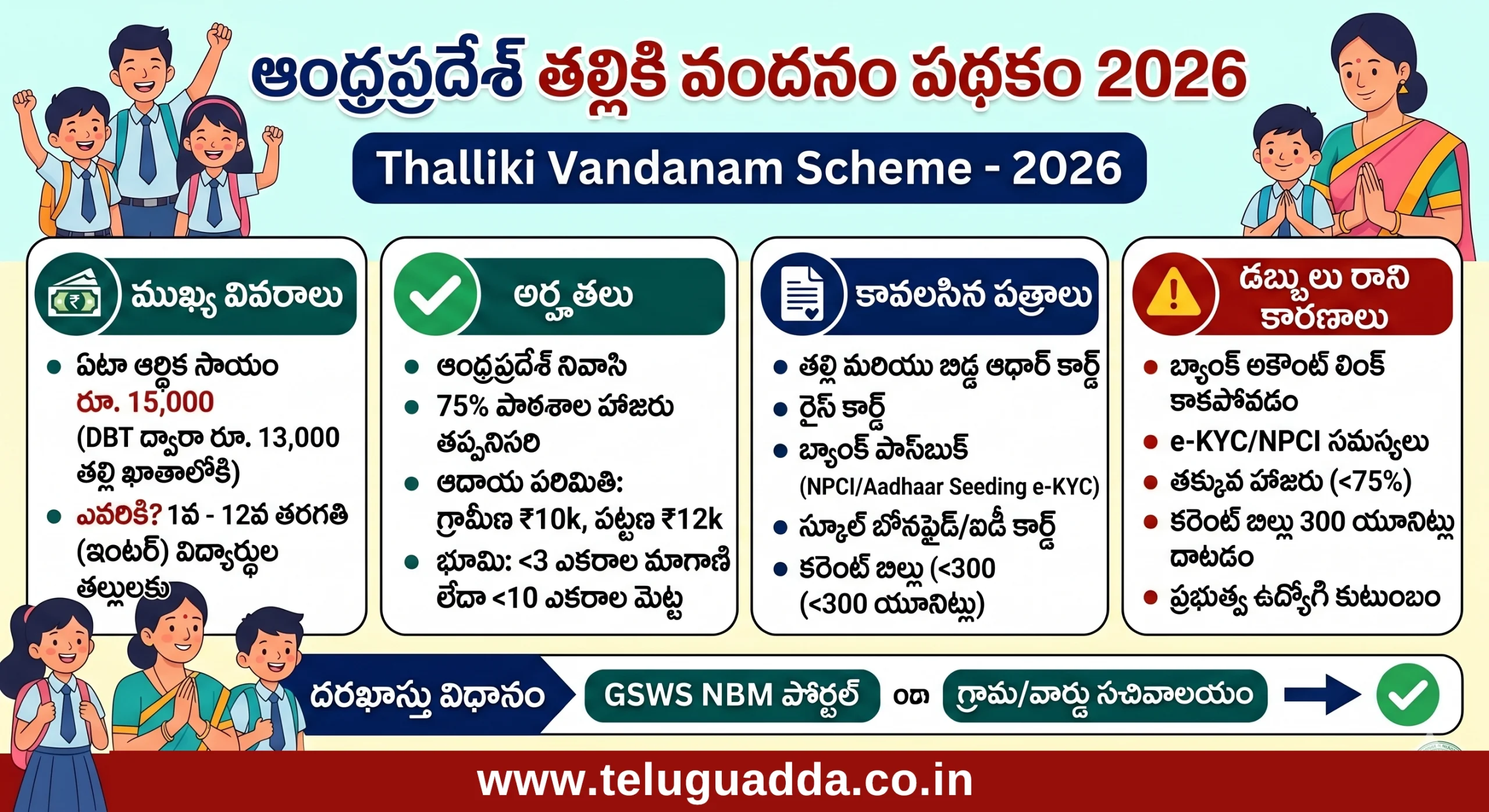
Thalliki Vandanam Status Check 2026
Key Highlights of the Thalliki Vandanam Scheme 2026
- Financial Assistance: 15,000 annually (A net amount of 13,000 is credited to the account after deducting school maintenance charges).
- Beneficiaries: Mothers or guardians of students studying from Class 1 to Class 12 (Intermediate).
- Selection of Beneficiaries: Money will be credited directly to the bank accounts of eligible mothers through DBT (Direct Benefit Transfer).
- Official Portal: GSWS NBM Portal (Navasakam Beneficiary Management).
Eligibility Criteria
To be selected as a beneficiary under this scheme, candidates must meet the following eligibility criteria:
- Residency & Education: The student and the mother/guardian must be residents of Andhra Pradesh. Children must be studying in recognized government or private schools/junior colleges in AP.
- Attendance Percentage: The student must have a minimum of 75% attendance in the respective academic year.
- Income Limit: The monthly family income must not exceed 10,000 in rural areas and 12,000 in urban areas.
- Land Holding Limit: The family must own less than 3 acres of wetland or less than 10 acres of dry land.
- Electricity Consumption: The average electricity consumption over the past 12 months must be less than 300 units.
- Government Employment: No one in the family should be a government or PSU employee (They should not be income tax payers).
- Rice Card: The family must possess a valid Rice Card.
Thalliki Vandanam Status Check 2026

Thalliki Vandanam Status Check 2026
- Open the official website >> Click Here
- Click on the “Thalliki Vandanam Status Check 2026” option.
- Select “2026-27” as the Academic Year.
- Choose “Thalliki Vandanam” under Scheme Type.
- Enter the mother’s Aadhaar number.
- Enter the Captcha code.
- Verify the OTP received.
- Your Eligibility and Validation Status will be displayed immediately.
Thalliki Vandanam Required Documents 2026
The following documents are required for applying online or for verification at the Secretariat:
- 🔹 Aadhaar Cards of both the mother and the student
- 🔹 Valid Rice Card / Ration Card
- 🔹 Bank Passbook of the mother (First page containing the photograph)
- 🔹 School/College ID Card or Bona fide Certificate of the student
- 🔹 Family Income Certificate
- 🔹 Electricity Bill number
- 🔹 The mother’s Aadhaar card must mandatory be e-KYC verified and linked to the bank account via NPCI (Aadhaar Seeding).
Application and Status Verification Process 2026
- Data Collection: School Headmasters (HM) enroll students’ details into the UDISE/Child Info portal.
- Secretariat Verification: Based on this data, the eligibility of beneficiaries is verified through the Village/Ward Secretariats.
- Status Check: The list of eligible beneficiaries is displayed at the Secretariats. Alternatively, individuals can check their ‘Thalliki Vandanam’ payment or eligibility status online on the official NBM portal by entering the mother’s Aadhaar number and OTP.
Main Reasons for Not Receiving Scheme Money
Although the Andhra Pradesh government is successfully depositing ₹13,000 into the accounts of eligible mothers, some people are not receiving the funds due to various technical and ground-level reasons. If money has not been credited to your account, it could be due to one of the following reasons:
- Bank Account Not Linked with Aadhaar & NPCI (Most Important Reason)
The government disburses this scheme money through DBT (Direct Benefit Transfer) directly into Aadhaar-linked bank accounts.
- The Issue: If the mother’s bank account is not linked to Aadhaar, or if the NPCI (National Payments Corporation of India) / Aadhaar Seeding mapping is inactive at the bank, the money will not be credited.
- Inactive Bank Account
- The Issue: If the bank account under the mother’s name has not been used for a long time, banks mark it as ‘Inactive’ or ‘Freeze’ it. In such cases, even if the government sends the money, it gets reversed.
- Issue 2: Mistyping the bank account number or IFSC code during the online application process.
- Electricity Bill Exceeding 300 Units
- The Issue: If the family’s average electricity consumption over the past 12 months exceeds 300 units, the system automatically marks them as Ineligible.
- Rented Houses Problem: In urban areas, if multiple families live in a rented house sharing a single electricity meter, and the cumulative bill exceeds 300 units, even eligible individuals in that house will lose out on the scheme.
- Lack of 75% School Attendance
- The Issue: Per the primary rule of the scheme, the student must maintain at least 75% attendance in the academic year. If the attendance drops according to Child Info or school records, funds will not be released.
- Household Mapping & e-KYC Issues
- The Issue: This happens if the mother and student are not registered under the same family unit in the State Household Database (Praja Sadhikara Survey), or if the e-KYC for either the mother’s or the student’s Aadhaar is incomplete.
- Land, Income, or Government Job (Six-Step Validation)
- The Issue: The scheme will be denied if the government’s ‘Six-Step Validation’ finds that you exceed the following limits:
- A family member is a government employee or pensioner (Sanitation workers are exempted).
- Family members are paying Income Tax.
- Monthly income exceeds 10,000 in rural areas and ₹12,000 in urban areas.
- The family owns more than 3 acres of wetland or 10 acres of dry land.
- Data Mismatch
- The Issue: If details like the student’s name or date of birth vary between school records and the Aadhaar card, the application gets rejected due to a data mismatch.
What To Do If You Have Not Received the Money? (Solutions)
- Check Status at Secretariat: First, visit your Village/Ward Secretariat and find out the exact reason for rejection from the staff using the NBM (Navasakam Beneficiary Management) portal.
- Rectify Bank Account Details: Check online or visit your branch to see which bank account is linked to your Aadhaar number. If the account is inactive, make a small transaction (deposit or withdrawal) to activate it. Ensure DBT/NPCI is enabled at the bank.
- Raise a Grievance: If you meet all eligibility criteria but missed out purely due to technical errors (e.g., faulty electricity bills or incorrect land records), you can file a grievance (complaint) at the Secretariat with proper supporting documents. Officials will re-verify your records, and if found eligible, the amount will be credited in the next installment.
